

Capital Raising
OPEN
VeinTech Pty Ltd
Vascular Access / Medical Devices
INDUSTRY
Medical & Healthcare
RAISING
$2.1M
VALUATION CAP
$41.7M
MINIMUM INVESTMENT
$100,000
Transaction Overview
Investment Highlights
Company Overview
Previous Funding & Key Investors
Products & Services
Announcements
Team
Transaction Summary
VeinTech Pty Ltd

Raising: $2.1M
Valuation Cap: $41.7M
Minimum Investment $100,000
Investment Highlights
Now demonstrated in real patients
VeinTech has completed its first 20 patient feasibility cases with Felix. In a DIVA-enriched population, every cannulated vein was located where Felix indicated, 100% of attempts targeted the forearm, and junior clinicians achieved 75% venepuncture success after only 15–30 minutes of device training and without additional cannulation technique or catheter education.
Core v1.0 risk materially reduced
The feasibility study supported progression of the v1.0 hardware and imaging algorithm and identified the remaining implementation gaps as predominantly clinician education, cannulation technique and catheter selection. The next phase is therefore focused on translating the technology into repeatable clinical adoption rather than proving the core imaging principle again.
Strategic partner has defined the next commercial proof points
A top-tier global vascular-access multinational is already an investor and strategic partner in VeinTech. The next evidence program is being designed around the two commercial outcomes that matter most to the strategic: habitual use of Felix and increased utilisation of premium IV catheters.
Large market with an additional premium-catheter conversion opportunity
More than one billion peripheral IV catheters are placed globally each year, yet the procedure remains predominantly guided by sight and touch. Felix is designed to make image-informed vessel and site selection practical for the generalist nursing workforce, while also enabling greater use of premium, longer-dwell catheters placed in appropriate vessels and sites.
Defined pathway to the next strategic inflection
The current SAFE funds a clear sequence of milestones: build the implementation playbook, validate it with the first US customer, complete FDA 510(k) clearance, execute the limited market release and measure habitual use and premium-catheter pull-through. Those data then inform a strategic transaction, licensing/distribution pathway or Series A commercialisation round.

First 20 Patients - The Milestones That Triggered This Raise
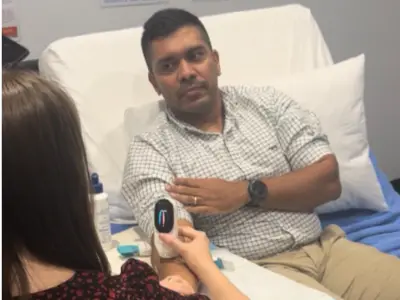
PIVOT-FS was designed as a feasibility study ahead of design freeze and the US limited market release. It tested Felix in real patients using predominantly junior clinicians with limited prior ultrasound experience.
Study characteristics
- 20 real patient cases
- DIVA-enriched population
- 67% of clinicians were junior and had little or no previous ultrasound experience
- 15–30 minutes of Felix device only training with no additional cannulation-technique or catheter-selection education
Takeaways
- 100% localisation accuracy
- 100% forearm placement
- 75% venepuncture success
- 100% venepuncture success when adjusted for identified PIVC technique, catheter-choice and clinician-experience factors
So what
Every case demonstrated that Felix could put the needle in the correct anatomical location. The study therefore shifted the remaining development focus from fundamental device performance toward the education, technique and catheter factors required to consistently complete the entire cannulation procedure.
Transaction Overview
Terms of offer:
- Security: SAFE Note
- Raise Size: $2.1M
- Valuation Cap: $41.7M
- SAFE Discount Rate: 30% until 15 October 2026, reducing to 20% thereafter
- Investor Protection: Investors receive the better of a $41.7M valuation cap or a 30% discount to the next equity financing price (20% discount after 15 October 2026).
- Expected Conversion Round: Company's next equity financing (targeted for Q4 2027)
- Minimum Investment: $100,000
Milestone-driven pre-Series A SAFE funding, FDA clearance, US commercial validation and limited market release.
What this raise buys:
- Build and validate the commercial playbook
Develop the education, competency and implementation program required for repeatable use of Felix, including cannulation technique and catheter selection, working with our Scientific Advisory Board and strategic partner. Validate this at our first US customer site.
- Complete FDA and execute the Limited Market Release
Complete the remaining FDA 510(k) program, manufacture and deploy units and execute the limited market release following clearance. The LMR is designed to establish habitual Felix use and premium-catheter pull-through in real clinical workflows.
- Advance v2.0 and cost-to-scale
Progress next-generation product development focused on reducing COGS and enabling a deployment model that supports significantly broader bedside access and potential bundling with premium PIVCs.
- Build exit readiness
Quantify the value Felix creates for strategic partners, model acquisition and commercial scenarios, and maintain strategic engagement ahead of the major evidence inflection points.
Every use of funds is tied to a defined risk-reduction or value-inflection event.
Company Overview

VeinTech is developing Felix, a radically simplified ultrasound platform designed to bring image-informed vascular access to the generalist clinicians who perform the majority of IV insertions.

Felix has now been used in real patients. In the first 20 patient feasibility cases, it achieved 100% localisation accuracy, 100% forearm placement and 75% venepuncture success after only 15–30 minutes of device training and no education on technique or catheter selection and usability.

The feasibility study has materially de-risked the v1.0 product, FDA pathway and identified the remaining implementation work primarily around clinician education, cannulation technique and catheter selection rather than fundamental device performance.

With a top-tier global vascular-access company already invested and participating in commercialisation planning, VeinTech is now progressing toward FDA clearance, US validation and a limited market release designed to measure habitual Felix use and premium-catheter pull-through.
Peripheral intravenous cannulation is the most common invasive medical procedure in healthcare, with more than one billion PIVCs placed globally each year. Yet the procedure is still predominantly performed using sight and touch, with published first-attempt failure rates commonly between 40–65%.
Ultrasound can improve vascular access, but conventional systems have not scaled into the generalist workforce because of three practical barriers: they take substantial time to learn, shared ultrasound carts are often not available at the bedside when an IV is required, and they are too expensive to deploy in the numbers required for routine coverage.
Felix is designed to remove these barriers. Rather than requiring clinicians to interpret conventional ultrasound images, Felix simplifies vascular access into four steps: Find, Assess, Select and Guide. It provides real-time information on vessel location, depth, diameter, flow and pathway so the clinician can identify an appropriate vessel and site before inserting the catheter.
The platform has now progressed from bench and healthy-human validation into real-patient feasibility. In the first 20 patient cases, including patients with difficult intravenous access, Felix achieved 100% localisation accuracy, 100% forearm placement and 75% venepuncture success with only 15–30 minutes of device training.
Critically, the study showed that the remaining implementation strategy to higher first-stick success is predominantly downstream of the imaging technology: clinician technique, catheter selection and education. That has defined the next phase of the company's development.
VeinTech is now building the clinical implementation playbook with its Scientific Advisory Board and strategic partner, validating it with its first US customer, progressing FDA 510(k) clearance and preparing for a limited market release.
The commercial thesis is broader than selling an ultrasound device alone. By helping clinicians consistently identify the right vein and site, Felix has the potential to enable increased use of premium, longer-dwell PIVCs. This creates value both for VeinTech and for strategic catheter manufacturers, opening avenues for licensing, distribution or acquisition.
VeinTech has established strong execution momentum, including:
Clinical validation: Evidence now extends from peer-reviewed bench and human studies into real-patient feasibility. Early clinical studies have demonstrated superior vessel visualisation and selection of higher-quality veins in patients with difficult intravenous access. In our latest feasibility study (first 20 patient cases cannulated), Felix achieved 100% localisation accuracy, 100% forearm placement and 75% venepuncture success after 15–30 minutes of device training. The study also identified the remaining success drivers around technique, education and catheter choice, informing the commercial implementation program now underway.
Intellectual property: Portfolio of 15 patent applications and granted patents protecting the core technology and future platform.
Regulatory & manufacturing: v1.0 product and imaging performance have progressed through feasibility toward final design freeze and production readiness. VeinTech operates under an ISO 13485-compliant quality system, has completed two FDA pre-submissions and is progressing a Class II 510(k) pathway ahead of the planned US limited market release in Q4 2026.
Commercial traction: A top-tier global vascular-access company is already a VeinTech investor and strategic partner. Following multi-layer diligence, the parties are actively working through commercialisation and limited market release planning. The next evidence program is focused on the two outcomes that matter most to the commercial model: habitual use of Felix and premium-IV pull-through.
Products & Services
Felix – Simplified Ultrasound-Guided Vascular Access
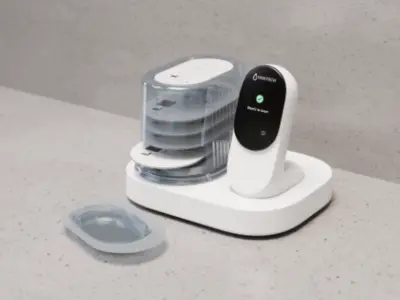
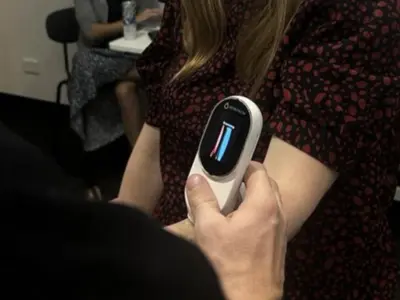
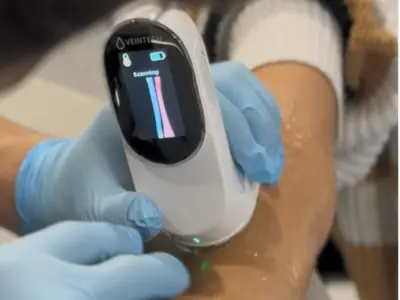
Felix is VeinTech’s handheld ultrasound platform for vascular access, designed specifically for the generalist clinicians who perform the majority of peripheral IV insertions.
Unlike conventional diagnostic ultrasound, Felix is purpose-built around the information required to make a vascular-access decision. Rather than asking the user to interpret a conventional ultrasound image, Felix simplifies the procedure into four steps:
FIND – Real-time vessel visualisation to identify veins that may not be visible or palpable.
ASSESS – Provides key vessel information including depth, diameter, flow and pathway.
SELECT – Helps the clinician identify a more appropriate vein and insertion site, including forearm sites associated with longer-dwell and premium PIVCs.
GUIDE – Supports alignment and insertion into the selected vessel by providing real-time location and depth information.
The platform is designed to address the major barriers that have prevented conventional ultrasound from becoming routine for peripheral IV insertion:
- Training burden: conventional ultrasound can require many hours of training, while Felix has been used after approximately 15–30 minutes of device training in VeinTech’s feasibility study.
- Availability: Felix is designed as a compact bedside device rather than a shared ultrasound cart that may not be available when an IV is required.
- Cost and scalability: the product architecture is designed to support broader deployment across hospital wards rather than concentrating imaging capability within specialist vascular-access teams.
Felix also forms the upstream layer of VeinTech’s broader commercial proposition:
The Whole One Stick
Right vein + right technique + right catheter
Felix supports identification and selection of the right vein and site.
The educators support the right insertion technique.
The strategic catheter partner provides the right catheter for that vessel and clinical need.
This is important commercially because the opportunity is not limited to selling an imaging device. By helping clinicians identify and access appropriate vessels more consistently, Felix has the potential to support increased utilisation of premium and longer-dwell PIVCs.
That end-to-end workflow is what VeinTech is now progressing toward commercial validation through its US program and limited market release.
Key Clinical & Economic Benefits
- Improves first-attempt cannulation success, helping reduce repeated needle sticks, treatment delays and escalation to specialist clinicians.
- Supports better vein, site and device selection, including appropriate placement of premium and longer-dwell PIVCs.
- Expands ultrasound-guided vascular access to generalist nurses, with Felix used after approximately 15–30 minutes of device training in the feasibility study versus the substantially higher training burden of conventional ultrasound.
- Helps reduce avoidable vascular-access complications and premature IV failure by supporting more informed vessel and site selection.
- Addresses a significant hospital cost burden, with published literature reporting approximately US$19,000 in additional hospitalisation costs per PIV complication.
- Supports a scalable commercial model, combining a lower-cost device platform, recurring consumables and the potential to increase utilisation of premium vascular-access products.
Target Customers
Primary initial customer:
Acute-care US hospitals, with generalist nurses performing high volumes of PIVC insertions.
Initial use cases:
- Patients with non-visible or difficult-to-assess veins
- Emergency departments and high-throughput hospital areas
- Oncology/infusion and repeat-access patients
- General wards where specialist vascular-access resources are not immediately available
Long-term opportunity:
Routine image-informed vascular access by the generalist nursing workforce.
The key shift is that Felix is not simply another tool for vascular-access specialists. The investment case relies on taking imaging into the workforce that performs the majority of IV insertions.
Next Generation Platform
Felix v2.0 is focused on making image-guided vascular access easier and more economical to deploy at scale, including:
- Lower COGS and simpler product architecture
- Further usability and workflow improvements
- Higher device density at the bedside
- Potential bundling with premium PIVCs
- Continued algorithm and decision-support improvements
The underlying platform also creates longer-term opportunities in adjacent applications, including paediatric and arterial vascular access.
Current capital remains focused on establishing Felix in peripheral IV access and proving adoption and commercial value.
What the Next 12 Months Prove
From “does it work?” to “what is it worth?”
VeinTech has progressively demonstrated:
- Find – accurately localise the vessel
- Assess – identify useful non-visible and non-palpable veins
- Select – shift clinicians toward better veins and sites
- Guide – translate imaging information into successful needle placement
The next evidence program addresses:
- Educate – standardise technique and catheter selection
- Cannulation – consistently complete the catheter insertion
- Manage – validate the full workflow and device selection
- Economics – quantify habitual use and premium-PIVC pull-through
This is the transition from technical validation to commercial validation.
Previous Funding & Key Investors
- Pre-seed Round: $0.3M (2021)
- Seed Round: $1M (2022)
- Growth Round: $3.1M (2025 - 2026)
Notable Investors:
- Australian and US Government grants (non-dilutive)
- Brisbane and Perth Angels
- Universities and medical research institutes
- Strategic US MedTech multinational partner
General Disclaimer
The content on this site is provided solely for information purposes, is not a recommendation or an offer to buy or sell a security and is not warranted to be correct, complete or accurate. This site is intended for Accredited/Sophisticated/Wholesale investors only. By continuing with an investment, you are self-accrediting that you so qualify. To the extent permitted by law, neither PrimaryMarkets, its affiliates, nor the content providers (such as the issuers of securities who appear on the site) are responsible for any investment decisions, damages or losses resulting from, or related to, the content, data and analyses or their use. The investment opportunities on this site and any statements made about them by their issuers are not vetted or verified by PrimaryMarkets. Investing in securities in private or unlisted companies and Funds is speculative and involves a high degree of risk. The investor must be prepared to withstand a total loss of their investment. We strongly encourage the investor to seek independent financial, professional or investment advice before investing in securities. The presence of an investment opportunities on this site should not be interpreted as an implied endorsement of it by PrimaryMarkets. Some content provided may constitute a summary or extract of another document. Past performance does not necessarily indicate future performance. The content on this site was current as at date of initial publication but may not be current as at the date of your viewing. For a more complete understanding of all the terms and conditions of your use of this site click here.
Want to learn more?
Fill in the expression of interest form below
Corporate Solutions
About
Solutions
Level 8, 8 Spring St, Sydney NSW 2000
2026 © PrimaryMarkets Pty Ltd.
All Rights Reserved
Corporate Authorised Representative: AFSL 485 946
Level 8, 8 Spring St Sydney NSW 2000


